Originally posted by Bisnow
Things are heating up for data centers.
The rise of artificial intelligence calls for more powerful graphics processing units and central processing units that generate more heat than older chips. While the last generation of GPUs and CPUs could be sufficiently cooled with traditional air-cooling systems, this new generation needs something different.
“Traditional air cooling systems just can’t remove the heat fast enough, so that means your computers can’t operate at the levels that they’re expected to, and you don’t get the performance out of your data center that you need,” said Thomas Steen, Chief Technology Officer, Nortek Data Center Cooling (DCC).
The solution, Steen said, is systems using liquid coolant instead of air to remove heat from chips. Some operators have been hesitant to adopt this new technology, however, due to a combination of misconceptions about liquid cooling and uncertainty over the best installation methods.
Steen spoke with Bisnow and broke down some of the key things data center operators should know about liquid cooling.
The Water Usage Myth
One common misconception about liquid cooling is that it uses more water than air cooling systems. This is a major concern for data center operators, who are already under pressure to reduce their facilities’ water usage.
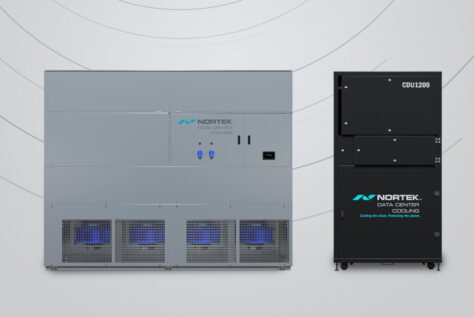
Steen said that liquid cooling is a closed-loop system, so it is constantly reusing liquid, not taking more. In these systems, contained fluid goes between the computer chip itself and a coolant distribution unit. That unit removes the heat from the fluid, transfers the heat to another fluid that’s also in a closed loop system and then the cooled fluid moves back to the chip to repeat the process.
He added that implementing liquid cooling for GPUs and CPUs does not make an air cooling system obsolete. Data centers typically employ a combination of air and liquid cooling, using liquid to take away that major heat source coming from the chips, and the rest of the electronics and other heat-generating sources within a rack will be handled with traditional air cooling.
One Size Does Not Fit All
When it comes to liquid cooling systems, a customized solution is best, Steen said.
“The rack that you’re using for your compute can be different for every data center, and often, the liquid cooling system that goes with those compute systems is pre-certified for each of them, so they’re different,” he said. “You’re going to have a different expected flow rate and a different expected entering and leaving temperature into the rack. You can’t have a one-size-fits-all approach when all of those parameters are changing depending on what type of GPUs and CPUs you’re installing.”
Owners design their facilities to use a certain amount of air-handling and liquid-cooling systems, with a specific capacity, flow rate, footprint, power and cost — and everyone will require a different solution, Steen said. This means they need suppliers to give them the custom and semi-custom systems and equipment that will allow their unique design to operate optimally.
This is where Nortek DCC’s C-Force comes in – an elite team of data center specialists built to move as fast as the industry does, with the flexibility and agility to meet customers wherever they are in their journey.